The short version
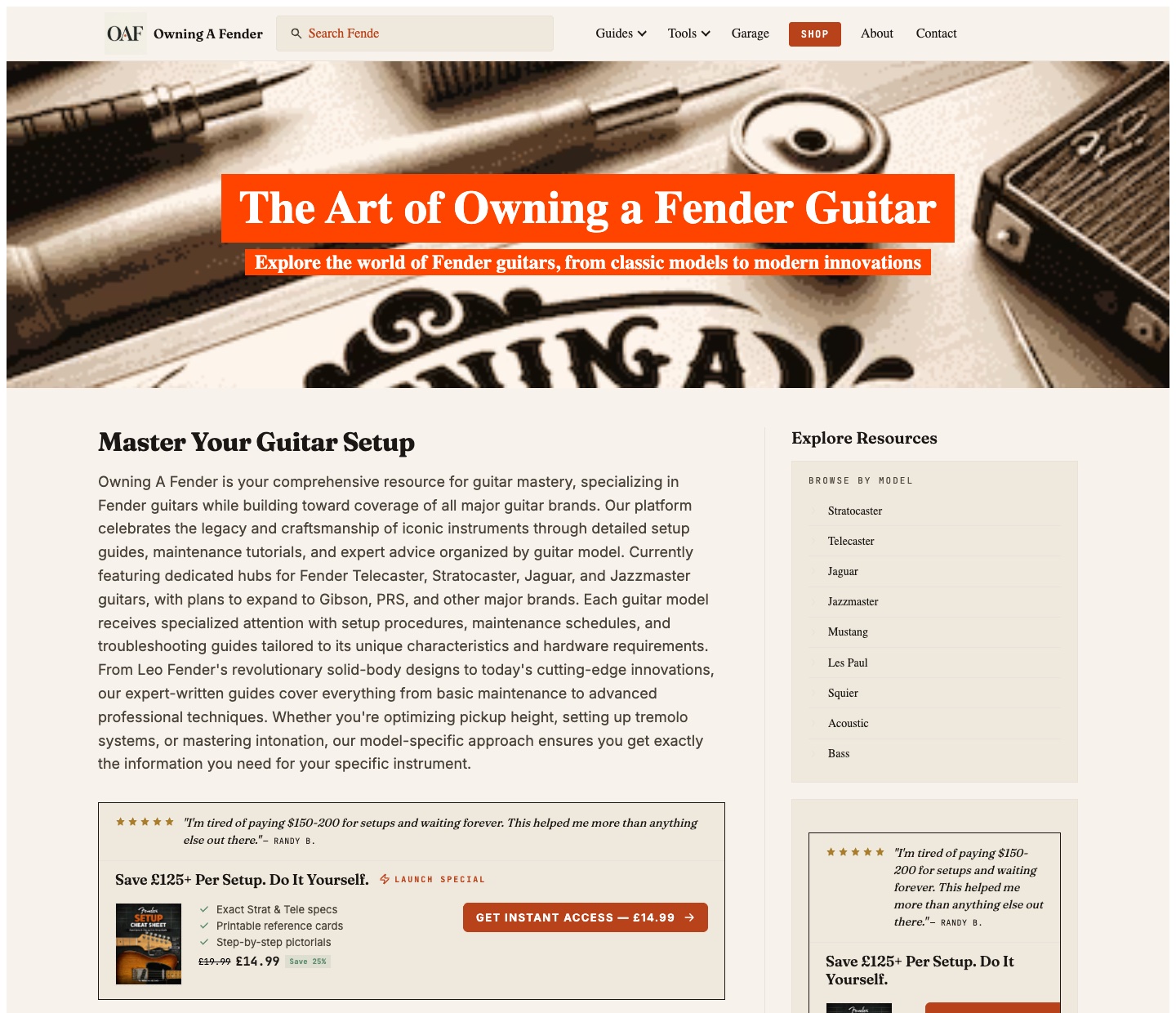
A few years ago I started a website about Fender guitars. Today it brings in around 16,000 clicks a month across all search engines — roughly 78,000 impressions a month on Google alone — ranks on page one for competitive searches across more than 20 guitar brands, and sells digital products through a checkout that runs itself. There’s no paid advertising, no social media grind, and no fulfilment work on my part — a customer buys, and the product arrives in their inbox automatically.
This is the story of how it got there, and what it taught me about building websites that actually pay for themselves.
What the site is
Owning a Fender is a resource for people who own — or are thinking about buying — Fender guitars. It has three main parts:
- Interactive tools. Serial-number decoders that tell you when and where a guitar was made, covering Fender, Squier, PRS, ESP, Martin and more than 20 brands in total, plus setup-spec lookups for things like string height and pickup adjustment.
- Guides and articles. Practical, detailed content: how to set up a Stratocaster, what a guitar is worth, how to spot a fake.
- Digital products. Premium setup guides sold as PDF reports, plus affiliate recommendations for tools and accessories.
The important thing to understand is that none of this was guessed. Every part of the site exists because the data said it should.
Letting the data write the content calendar
Most small-business blogs fail the same way: the owner writes about what they find interesting, publishes into the void, and gives up after six months. I took the opposite approach.
Google Search Console tells you exactly what people typed before they landed on your site — including the searches where you appeared on page two and almost nobody clicked. Those “almost ranking” queries are gold: Google already trusts you on the topic, you just haven’t given it a good enough page yet.
So the content calendar isn’t a list of ideas. It’s a list of queries pulled from Search Console, sorted by impressions. If thousands of people a month are searching for something and my site shows up at position 14, that’s the next article. Each post is built to properly answer the query — specific measurements, step-by-step instructions, an FAQ section, and structured data (the behind-the-scenes markup that helps Google show rich results like FAQ dropdowns and how-to steps).
It’s unglamorous and it works. Rankings compound: every post that climbs onto page one makes the next one easier to rank, because Google increasingly sees the site as an authority on the subject.
Interactive tools as the traffic engine
Content alone is a slow game. The site’s real engine is the serial-number decoders.
Here’s the insight: someone who just bought a second-hand guitar, or is about to, wants to know one thing — is it real, and when was it made? They search “PRS serial number lookup” or “Squier serial number decoder”, and they want an answer in ten seconds. A blog post can answer that, but a tool answers it better. Type in the serial number, get the year, the factory, and what to check next.
Tools like this earn rankings that articles struggle to get, because they genuinely satisfy the search better than text does. The PRS, Squier and ESP decoders each sit around positions 5–6 on Google and pull in hundreds of clicks a month each. And once someone has used the decoder, they’re one click away from an authenticity guide or a setup guide — which is where the products come in.
For a small business, the lesson generalises: a calculator, a configurator, a quote estimator — anything that does something rather than just saying something — can become your best-performing page.
The technical shape, in business terms
I’ll spare you the architecture diagram. What matters commercially is this:
- The site is static. Pages are pre-built and served from a global content-delivery network. There’s no server sitting there costing money whether anyone visits or not. Hosting costs are close to zero, and the site loads fast everywhere — which both visitors and Google reward.
- Payments run through Stripe. A customer clicks buy, pays by card, and Stripe handles the entire checkout — currencies, receipts, the lot.
- Fulfilment is automated. A purchase triggers a small serverless function (code that runs on demand, billed in fractions of a penny) that generates the PDF report and emails it. No manual delivery, no “I’ll send that over tonight”. The shop is open 24/7 whether I’m awake or not.
The result is a business with near-zero marginal running cost. Whether ten people or ten thousand visit today, the bill barely changes, and no sale ever waits on me. That’s the difference between a website and a product.
The honest numbers
I promised honesty, so here it is:
- ~16,000 clicks a month across all search engines — ~78,000 impressions a month on Google alone, all organic, no paid acquisition.
- Page-one rankings (positions ~5–6) for decoder queries across 20+ guitar brands.
- Digital products sell and fulfil automatically through Stripe — I won’t quote revenue figures here, but the point is the mechanism, not the amount: every sale is pure margin because there’s no cost of delivery and almost no cost of operation.
Sixteen thousand clicks a month won’t make the front page of Hacker News. But it’s a real, compounding asset built in spare hours — and it proves the approach works. Traffic arrives every day from work I did months or years ago, and the trend line points up.
What this means for your business
Everything on this site transfers directly to client work. If you’re a founder or an independent business, the same playbook applies: find out what your customers are actually searching for, build pages — and where possible, tools — that answer those searches better than anyone else, structure the site so Google understands it, and automate the boring parts of selling so a website enquiry or purchase never waits on you.
That’s what I do for clients: strategy, design, build, hosting, SEO and the automation behind the checkout, as one joined-up piece of work rather than five separate suppliers.
You can read the full breakdown of the site — the tools, the content system, the stack and the results — in the Owning a Fender case study, or get in touch if you’d like to talk about doing something similar for your business.