Why I built this
owningafender.com works, and the part that works hardest is awkward to explain: a free serial-number decoder. People land on it from a specific, high-intent search (“what year is my guitar”), get a fast, useful answer, and a meaningful share of them then find the paid offers on the same surface.
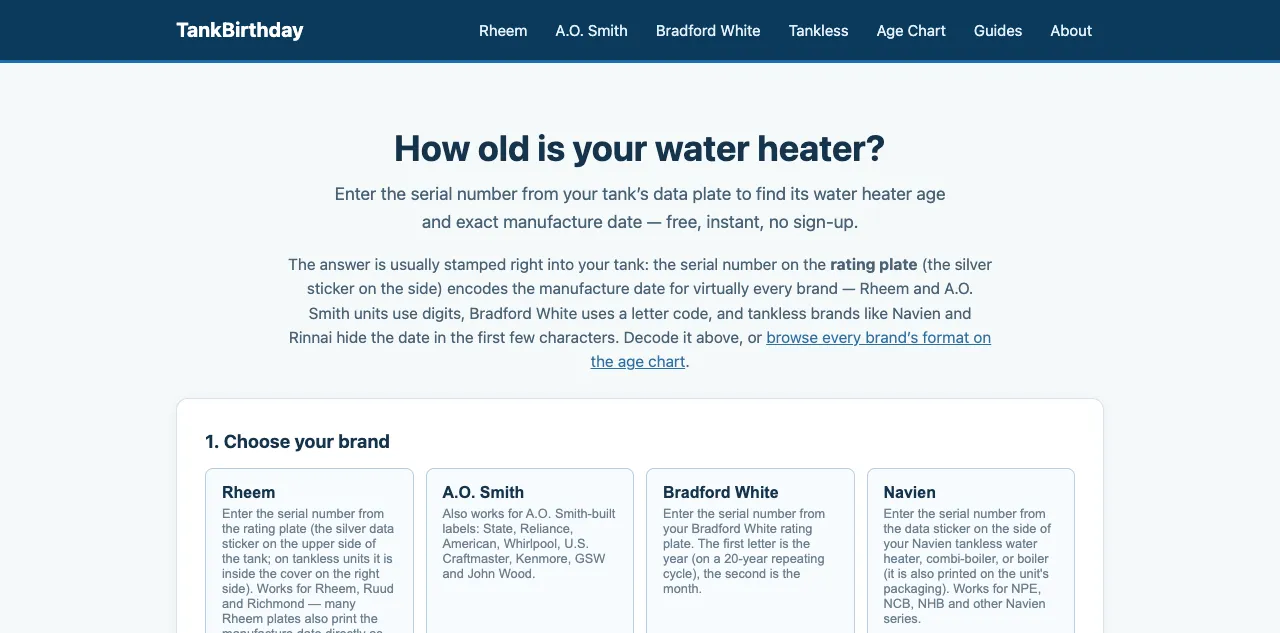
I’ve been curious whether that’s a guitar thing or a playbook thing. So I built tankbirthday.com — a free decoder that tells you a water heater’s age from its serial number. Same shape, different niche, and this time deliberately built to test the transfer, not to chase a hunch.
The niche
Water heater age is a genuinely searchable problem. Homeowners, plumbers and insurance forms all eventually ask some version of “how old is my tank?”, because:
- It’s stamped into the serial number on the rating plate — the answer is sitting on the tank.
- Warranty and replacement decisions hinge on it (“is my 15-year-old Rheem worth keeping or is it leaking-by-date?”).
- Every brand encodes it differently, so the lookup isn’t something people can just do once — it needs a reference.
It’s the right kind of search to build a tool around: specific, repeated, and with real intent behind it.
What I built
A single-page decoder plus a reference age chart, covering the formats that actually appear on tanks in the US:
- Rheem / Ruud / Richmond — digit-based date codes (and many plates print the MFG date directly).
- A.O. Smith — and the A.O. Smith-built brands (State, Reliance, Whirlpool, Kenmore, John Wood…).
- Bradford White — a letter code for the year (on a repeating cycle) and a letter for the month.
- Tankless brands — Navien, Rinnai and others hiding the date in the first few characters of the serial.
The whole thing is a static site with a small serverless backend — the same near-zero-cost pattern as owningafender.com. Running it costs almost nothing, which is exactly why I can afford to test niches like this at all.
What I’m testing
I’m treating this as an experiment, so the honest framing matters:
- Will the tool rank for the long-tail serial/age queries? That was the killer move on owningafender, and it’s the part that compound only if search traffic arrives.
- Does decoder traffic convert on a paid offer here? A water heater isn’t a guitar — the monetisation (if any) won’t be identical, and I’d rather find that out on a cheap experiment than bet on it.
- Does the playbook’s shape transfer? Free tool → useful answer → adjacent products/affiliates → email. If it works here, it’s a reproducible engine, not a one-off.
It’s early — the site is live but the search traffic is still building. The point was always to test the model, and a site that costs pennies to run is the cheapest way to do that.
The takeaway for me
Building a second decoder was faster than the first, not just because the code was reusable but because the playbook was: find a high-intent lookup, build the smallest tool that answers it, let SEO do the acquisition, keep the cost near zero while you learn. tankbirthday.com is my attempt to prove that pattern transfers — and to find out what’s niche-specific along the way.
If you’re curious, try it — enter a serial from your tank’s rating plate and it’ll tell you how old it is.